
Risk management


Getting protected
Insurance premiums may have rocketed for power companies over the past year but new ‘dual-trigger’ insurance products could still be an efficient way of transferring price risk. James Ockenden reports
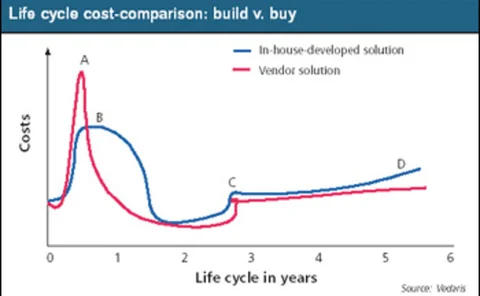
Build in or buy out?
Is it more cost-effective for companies to buy available systems from vendors or to develop and deploy their own energy trading and risk management solutions? Bob Bridger of Vedaris looks into the dilemma faced by many companies
Doing the maths: physical value-at-risk
ABB’s William Rutz and Bob Fesmire investigate new tools that calculate physical value-at-risk based on simulations of generating resources and power transactions
A joint state-space model for spot and futures power
Portfolio-wide risk management requires a model that accounts correctly for correlations between the spot asset and various futures products. Kjetil Kåresen and Egil Husby discuss a joint multi-factor model for power spot and futures prices and show how…
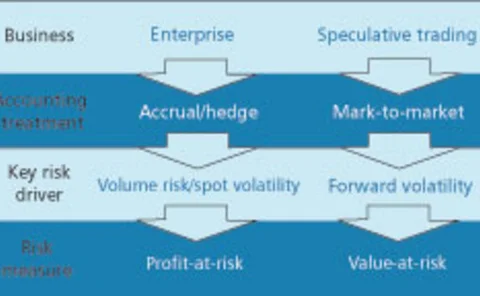
Know your trade types
An accurate and clearly communicated classification of the types of trade a company carries out brings a better understanding of risk methodologies and where they are best used across the enterprise, says Greg Keers
The CRO road
A company-wide understanding of risk has never been more important for energy firms. Kevin Foster talks to three chief risk officers about their role and how it is changing
The three-way knock-on effect
Peter Nance and Lin Franks look at the interplay between market, credit, and operational risks and consider how firms might approach implementing an integrated company-wide system to tackle them
Untangling the web
Ruling out the need for a major software infrastructure project, web-based concepts make perfect sense for enterprise-wide risk management systems, says Martin Chavez

From Enron to Iraq
The freight derivatives market has ridden out the loss of market-maker Enron, and now all eyes are turning to the effect of military action against Iraq. By Kevin Foster
Keeping EAR simple
Brett Humphreys discusses how trading groups can be captured within earnings-at-risk and cashflow-at-risk models. He suggests taking a top-down approach instead of a bottom-up approach based on actual positions

Close-up on market risk capital
Jack Kennedy outlines rating agency Standard & Poor’s new approach for analysing the credit quality of US energy trading firms
Estimating oil price volatility: a Garch model
Nikolai Sidorenko, Michael Baron and Michael Rosenberg present a general framework for modelling energy price volatility. These models explain the volatility persistence and clustering present in many commodity prices. In addition, they can incorporate…
Managing risk under SMD
Scott Greene, Mark Niehaus and Pankaj Sahay examine the impact of Ferc’s proposed standard market design on power risk management

Clear in present danger
Energy companies are crying out for clearing solutions to reduce their counterparty credit risk. James Ockenden looks at new initiatives from London-based power exchange UKPX and German firm Clearing Bank Hannover

The rise of the money men
Wanted: company to trade power in the US. Strong credit, trading expertise and appetite for risk required. Only banks need apply? By Kevin Foster

A credit boost for traders
Clearing houses are emerging as a crucial function of energy trading exchanges. John Kennedy explains their importance in terms of a firm’s credit rating
Keeping an eye on the long-term
Brett Humphreys discusses the problems with standard credit risk limits and proposes limits that may work better

Var too far
The energy industry has shown tremendous commitment to value-at-risk (Var) methodologies. But use of Var has been misguided, as James Ockenden discovers

Online trading moves forward
Online energy trading seems to have a bright future, despite the two biggest players – Dynegy Direct and EnronOnline – leaving the market, finds Catherine Lacoursière
Exploring option pricing with mean-reversion jump diffusion
Yijun Du explores option pricing with a mean-reversion and jump-diffusion – or MJ – model, using Monte Carlo simulation. We find that jumps can increase the call price, a higher mean-reversion rate lowers the call price and the time to maturity has…