
Analysis
Making an impact
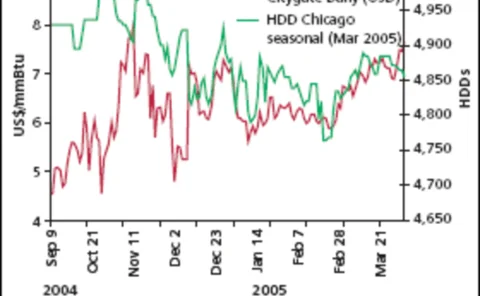
It can affect as much as 20% of the US economy, and nearly every industry worldwide is affected by it. But blaming poor results on the weather is no longer an excuse: weather derivatives are on the rise. Eric Fishhaut reports from Chicago on the growth…
Banking on tankers
Logical Information Machines’ Sandy Fielden provides an analyst’s perspective of new opportunities for freight risk management with a specific focus on the crude (dirty) tanker trade from the Caribbean to the US Gulf
LNG makes headway
The market for liquefied natural gas is ripe for expansion, given the scarcity of oil and LNG’s cleaner burning properties, and a short-term market is emerging for the first time. Eric Fishhaut looks at the evolving structure of this international market
The future of the floor
There have been many reports and studies comparing open-outcry and electronictrading and advocating one platform or the other.With the IPE putting all ofits eggs in the electronic basket last month, it is a great time to analyse thesituation and ask the…
Petroleum price surges
Oil prices once again are on the rise, with some analysts predicting ‘super-spikes’ in the near future to match the price rises of the 1970s. Eric Fishhaut summarises some of the key changes, and looks at how traders can make use of the volatility in the…
Shopping for curves
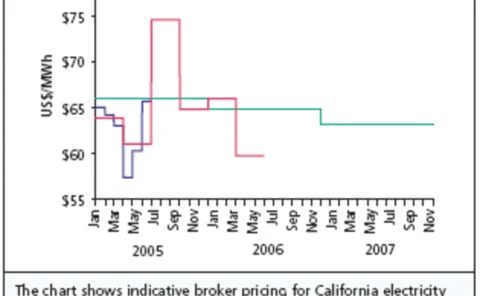
More regulation requires more accurate valuation of forward trades – and a need for more reliability in the forward curve tool. Sandy Fielden presents an informal survey of the data choices available to energy risk managers in the US natural gas and…

The basics of basis
Basis plays an important role for trading in the very complex US natural gas markets: spot will differ from the benchmark Henry Hub New York Mercantile Exchange price on the same day. Eric Fishhaut describes how the basis works and demonstrates the…
Evolution in energy
The price of oil has undoubtedly been the top story in the energy sector overthe past year or so, but examined over a period of 10 years, the picture looksmore stable. If there’s one trend that has changed the energy markets inthe past decade, it has to…
Benchmark in limbo
The development of a spot market for crude oil in the 1980s eventually led to oil futures trading and the need for benchmark pricing. With oil prices fluctuating wildly in the region in tandem with markets across the globe, theneed for price transparency…
Driving up the price
Nowhere has the spiralling cost of petroleum been more acutely felt than in the US, where the car is king. The rise is, of course, directly related to high crude oil prices, pushed ever higher by threats to production arising from worldwide political…
Grain versus cane
Since Nybot listed a new futures contract for ethanol in May, the product hasemerged as a critical ingredient in US refining. Gasoline traders may find themselvesworrying about crop reports as much as they monitor Opec meetings and Nymex crude. Sandy…
Dealing in doubt
Scepticism still surrounds the EU’s National Allocation Plans for theEuropean Emissions Trading Scheme (ETS) starting in January 2005. IvanO’Toole discusses the cost implications of the Kyoto Protocol for the EU power industryand anticipates a few…
The fuel of the future?
Could coal as a source of electricity generation be back on the monitors of many US utilities? Logical Information Machines’ Sandy Fielden looks at the reasons behind higher coal prices in the country and considers whether coal can really compete in the…
A fact of life?
Can the price risks associated with abnormally cold winter temperatures and theirimpact on short term energy demand be predicted ahead of time? Logical InformationMachines’ Sandy Fielden investigates recent freezing temperatures in Boston,Massachusetts
Upwardly mobile
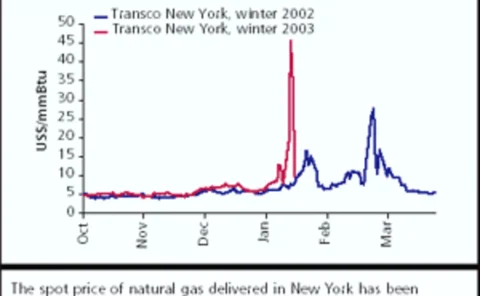
As energy prices creep upward, many factors are driving the markets. The upward trend and increased volatility is continuing as the markets evolve and mature. But are these markets operating efficiently and accurately, or are they being manipulated, as…
Weathering the storm
Natural gas markets are thought to be one of the most sensitive to changes inthe weather, but how much do other factors affect price movements? MaryAshleyHall , energy market specialist with Fame, looks at some tried and tested methodsof managing weather…
Life without MTBE
The changeover from the use of MTBE as a gasoline blending component, to ethanol,in New York State and Connecticut on January 1, 2004 is likely to lead to pricevolatility in the oil market and make risk management using the Nymex Unleadedcontract far…
LNG could rescue the US
Sandy Fielden of energy market specialist Logical Information Machines looks at a potential solution to the US natural gas supply crisis: liquefied natural gas
From a gas crunch to a crisis
In this month’s Market Focus, GlobalView Software takes a look at the factors contributing to the current US natural gas crunch, which is drawing the attention of major political and financial figures
Oil prices cause ripples in chemicals market
The chemicals market has been hit by the effects of high oil prices. Higher feedstock prices have brought higher end-product prices. Fame Information Services looks at styrene prices and the soaring costs of feedstocks, particularly in the ethylene market
The cost of deregulation
US electricity deregulation does not necessarily make prices more competitive, as is shown in this study of New England power prices by Logical Information Machines
Petrochemicals firms take a stand against oil price volatility
Many petrochemicals firms are seeking to reduce price volatility through hedging, given that the cost of crude oil is strongly influencing the price of petrochemical products. GlobalView Software looks at the figures behind the trend
Rethinking European power
European energy firms are seeking to reposition their products and strategies in advance of European Union market deregulation. FAME Energy reports
US energy prices: in line for a fall?
A combination of concerns in the second half of January 2003 has boosted US oil and natural gas prices to levels not seen since the winter of 2000/2001. Will the higher prices stick? Logical Information Machines examines cause and effect