Commodities Trading and Investment Summit: conference highlights
Up for debate
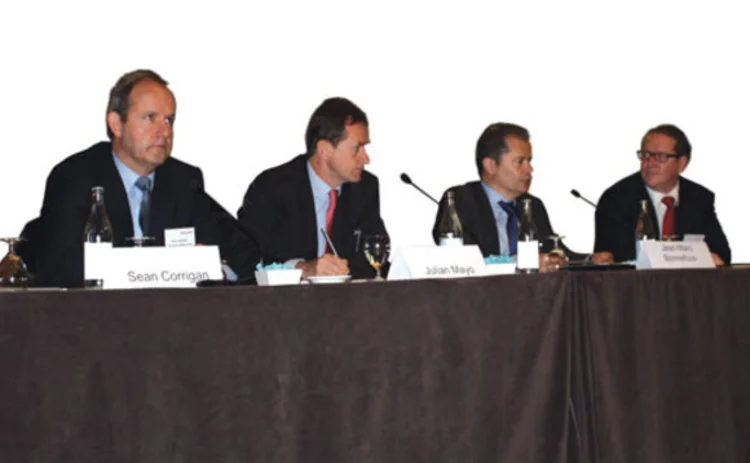
Fund managers, chief investment officers, investment consultants, and traders gathered in the Hotel President Wilson next to Lake Geneva on June 21 for Energy Risk’s inaugural Commodities Trading and Investment Summit, which attracted a panoply of speakers analysing commodity markets and investment strategies.
A broad examination
Keith Wade, chief economist and strategist at Schroders, kicked off proceedings with his macro view of the economy and the outlook for commodities.
Although China has become the world’s largest energy consumer, it still has a long way to go on a per-capita basis, Wade said. The average Chinese person consumes two barrels of oil per year compared to an average of more than 20 barrels in the US. If China were to match US consumption levels, it would require all the world’s current energy supply.
Wade next analysed the chances of several key emerging markets overheating. He noted that food price increases had a much bigger impact on inflation in developing countries because they formed a greater proportion of people’s personal expenditure and, hence, of the overall basket of goods used to measure inflation.
Nevertheless, Wade said Schroders foresaw a soft landing in China and did not put any serious weight to the scenario of the Chinese bubble bursting and dragging down the world economy.
Risk watch
Next up was Tony Hall, explaining the approach of Duet Commodities Fund to managing market risk. The fund is agnostic on price direction, it expects 20% returns year on year, and is run on 99 Value at Risk, one-year one-day historical, Hall said. As well as the usual stress tests, Duet runs scenario-specific analyses, testing the resilience of the fund to specific extreme market-moving events.
Following Hall’s talk was a panel discussion on emerging market risks. Julian Mayo, co-chief investment director at Charlemagne Capital, pointed out that China was still at an early stage of development. Convergence between the developed and developing world could actually happen with the shrinking of incomes per capita in the West, particularly with the US recovery losing steam, he said.
Jean-Marc Bonnefous, managing partner at Tellurian Capital Management, criticised the simplistic approach of treating commodities as just a gross domestic product (GDP) trade. Sean Corrigan, chief investment strategist at Diapson Commodities, agreed there was only a loose correlation between GDP and commodity prices.
Bonnefous stressed the magnitude of sharp slowdown in growth in China for global commodity markets. “If there’s a hard landing, they will sell everything,” he said, explaining that this presented the opportunity to buy lots of commodities cheaply and profit over the next five years.
The panellists clashed on whether quantitative easing (QE) in the US was helping or hindering China. Some thought China was telling the US to stop QE, while secretly wanting it.
But Mayo argued that the unpopularity of QE in the US was because it transferred wealth from the middle class in the long term, to traders and bankers in the short term.
Corrigan criticised the widespread adulation of the Chinese economy as misplaced, criticising its centralised model as creating major distortions and inefficiencies. The mass power shortages in China were because of price suppression, he argued.
More on Risk management
Energy risk teams adapt hedging practices amid volatility
Risk managers at European power and gas firms are taking new approaches to hedging amid today’s turmoil and uncertainty. Mark Nicholls reports

CRO interview: Antoine Servais
MET Group's Antoine Servais discusses the impact of geopolitical risk on his workflow, his approach to volatility, and the challenges of leading risk management at a rapidly expanding organisation
Energy supply chain challenges prompt risk management rethink
As supply chain challenges grow, energy risk managers are taking a more dynamic and holistic approach to managing and anticipating supply chain risk, say Sapna Amlani and Stephen Golliker at Moody’s

Energy Risk Europe Leaders’ Network: the challenge of unpredictability
The European Leaders’ Network, sponsored by Engie, convened in London on June 29, 2026, and focused on the impact of geopolitical tension, price volatility and policy uncertainty on European energy markets.

Break down silos to manage geopolitics – risk managers
Risk Live: Experts says scenario planning helps identify who has information needed in a crisis

Treat AI models as would-be hackers, says quant
Risk Live: Models capable of “strategic deception” require different risk management, says former Risk.net quant of the year

AI autonomy may redefine risk management roles
Risk Live: Machine validation of autonomous processes may emerge “relatively soon”, EIF risk chief says

Managing extreme volatility in commodities
Persistent volatility requires a rethink of technology architecture, says Murex head of market risk practice